
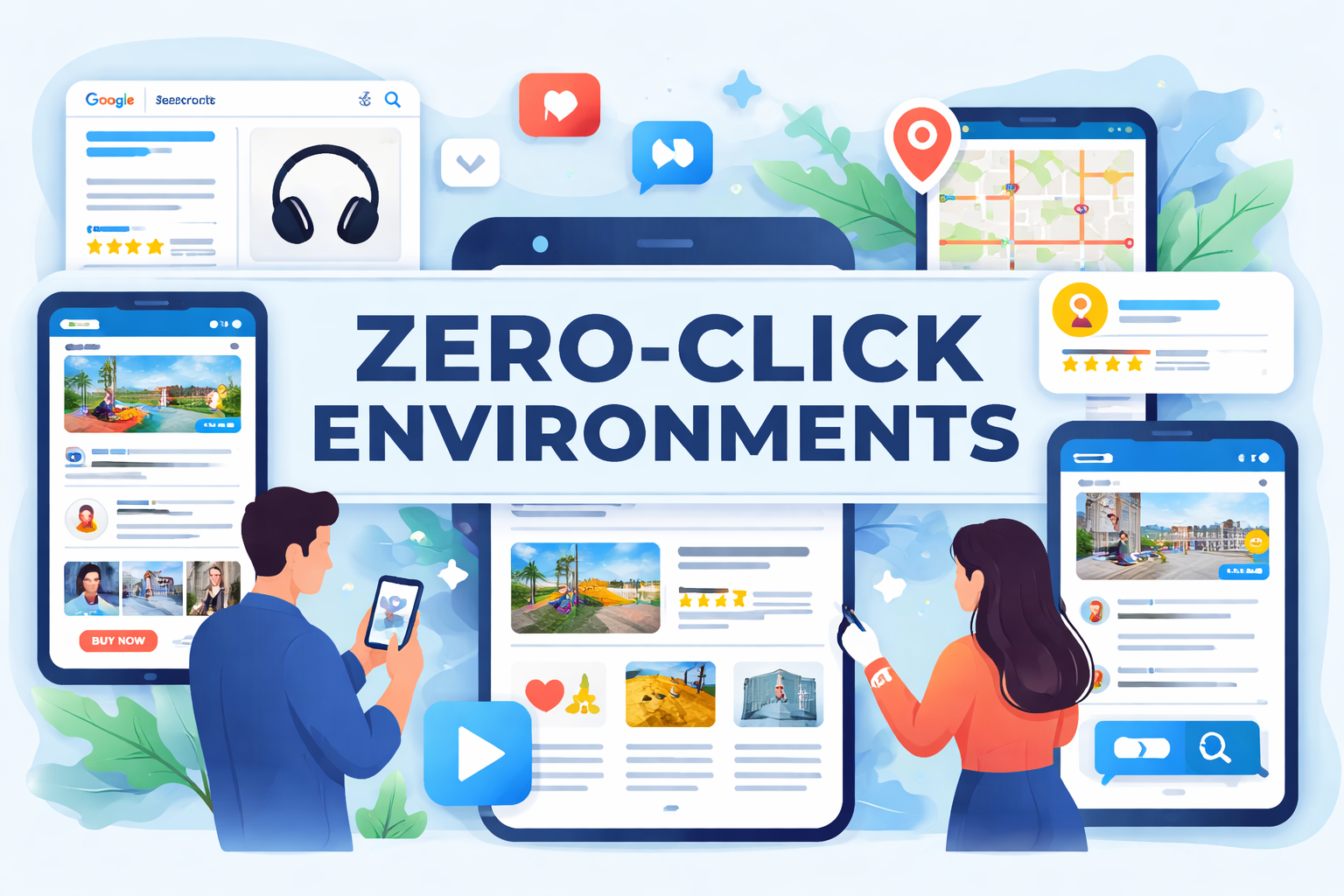
Zero-Click Environments: How Online Research Is Changing, and What It Means for Advertisers
Consumers are increasingly getting the answers they need without ever clicking through to a website. This shift toward
zero-click environments is changing how people research products, plan vacations, compare services, and make purchase decisions.
For advertisers and brands, it creates a new reality: you can be discovered, considered, and even chosen, without winning the click.
What Is a Zero-Click Environment?
A zero-click environment is any digital experience where a user’s question is answered directly within the platform,
eliminating the need to visit an external website. Instead of a traditional “search, click, browse” flow, the user stays in the same
interface to gather information and move closer to a decision.
Common Zero-Click Examples
- Search results pages with featured snippets, “People also ask,” and AI-driven summaries
- Map listings showing hours, photos, pricing indicators, FAQs, and reviews
- Social platforms where creators and brands publish complete research-ready content
- Video platforms where product comparisons and travel guides happen entirely in-stream
- Marketplace and retail media ecosystems where discovery and purchase happen in one place
Zero-click does not mean “no interest.” It often means “faster research,” with less reliance on brand-owned websites.
Why Zero-Click Behavior Is Growing
Zero-click behavior is accelerating because consumers increasingly prioritize speed and simplicity. Search engines and social platforms
are intentionally designing experiences that deliver immediate answers through featured snippets, AI-generated summaries, embedded reviews,
and structured product data. On mobile devices especially, fewer clicks mean faster decisions. At the same time, AI integrations are consolidating
information from multiple sources into digestible summaries, compressing the traditional research journey into a single platform interaction.
The result is a more efficient user experience, but one that limits direct traffic to brand-owned properties.
How This Impacts Advertisers and Brands
Zero-click environments are reducing traditional website traffic, even when interest remains high. That creates measurable consequences across
SEO performance, analytics visibility, attribution models, and the overall ability to build direct customer relationships.
| What Changes | What Brands May Notice | Why It Matters |
|---|---|---|
| Organic clicks decline | Impressions stay steady, but sessions drop | Rankings alone do not guarantee traffic or conversions |
| Less on-site behavior data | Fewer retargeting signals and weaker funnel insights | Harder to personalize, optimize, and measure incrementality |
| More platform dependence | Higher reliance on paid media and native formats | Visibility and conversion happen inside ecosystems you do not own |
| Attribution becomes murkier | Last-click conversions underreport influence | Brand lift, assisted conversions, and view-through metrics matter more |
Where Brands Lose the Most
Brands tend to feel the biggest impact when their strategies rely heavily on driving sessions to a website for engagement and conversion.
If a consumer can compare options, read reviews, and build confidence inside the platform, the click becomes optional. That makes
visibility and message retention as important as traffic.
Strategic Adjustments for Advertisers
To remain competitive in zero-click environments, advertisers must shift from a traffic-first mindset to a visibility-first strategy.
Rather than optimizing solely for clicks, brands should ensure their content is structured for search features, AI summaries, and in-platform
discovery tools. Investing in native lead forms, shoppable posts, and platform-based conversion opportunities allows brands to capture demand
where it is forming. At the same time, strengthening brand recall through consistent creative messaging becomes essential, since decisions may be
made without a website visit. Finally, prioritizing first-party data capture through email programs, loyalty initiatives, and post-engagement
remarketing helps brands maintain long-term audience ownership in an increasingly platform-controlled ecosystem.
Practical Actions You Can Implement Now
- Audit search and map listings for accuracy, images, reviews, FAQs, and “above the fold” completeness
- Publish platform-native content that answers common research questions clearly and quickly
- Use paid media formats built for in-platform conversion, including lead forms and shopping integrations
- Track beyond last-click, include view-through impact, assisted conversions, and brand lift where available
- Offer value exchanges to grow first-party lists, such as guides, deal alerts, early access, or planning tools
The Bigger Picture
Zero-click behavior does not mean users are less interested, it means they are more efficient. Discovery, research, and evaluation are increasingly
happening inside search results, social feeds, maps, and marketplaces. For brands, the goal is not to “fight” that reality. The goal is to design
for it, ensure your information is visible where decisions are being formed, and build enough brand recognition that users choose you even when the
click never happens.
FAQ: Zero-Click Environments
Does zero-click mean SEO is less important?
SEO is still critical, but success is increasingly tied to visibility and influence, not just sessions. Structured content, strong listings,
and being cited in summaries can matter as much as traditional traffic.
How should we measure performance if traffic declines?
Expand measurement to include impression share, engagement, view-through results, assisted conversions, and brand lift. Pair these with
first-party data growth to protect long-term performance.
What is one quick win for brands new to this?
Make sure your map and directory listings are complete and current, then create short, direct content that answers top questions within
the platform where your audience is researching.
Put the insight to work.
Connect what you have learned to your next audience, media plan and campaign.
Discuss your campaign ↗
